Oseguera, Mariana. [Title removed for blind review] .
Higher education credentials have long been central to organizations’ hiring practices and job seekers’ access to white-collar occupations. Yet, the rise of new technologies has expanded access to skill-building resources, potentially increasing opportunities for candidates who acquire skills through alternative pathways. In response, some employers have removed degree requirements from job postings to signal openness to these candidates. Using a large-scale audit study with nearly 18,000 applications for software and marketing jobs, I examine how employers evaluate qualified non-degree holders based on non-degree signals of skills and fit—including years of relevant experience, employment at a prominent firm, and micro-credentials—employers’ stated degree requirements, and candidates’ gender and race. The results show that alternative-routes candidates received 28% fewer callbacks than degree holders with the same years of relevant experience, and this difference persisted even when job postings did not require a college degree. However, the gap disappeared when alternative-routes candidates had twice as much relevant experience as their degree-holding counterparts. Other skill signals had little effect on callbacks for non-degree holders. Lastly, while alternative-routes candidates did not experience different callback rates based on race or gender, the effect of degree status varied across demographic groups depending on job requirements and occupation type. Overall, this study sheds light on the boundary conditions of credentialism and has implications for firms’ human capital strategies, diversity in professional jobs across class, gender, and race, and the future of work.
Oseguera, Mariana. “Skill-Based Hiring: A Path to Better Matches and Greater Opportunity?”
In this field experiment, I investigate how firms’ skill-based hiring approaches—such as eliminating degree requirements and signaling openness to candidates who have acquired skills via alternative routes—impact the applicant pool in terms of job-required skills, educational background, race, and gender. I partnered with two firms to conduct a reverse-audit methodology as they actively hire for positions in software, marketing, and office administration. Partnering companies agreed to randomly manipulate the degree requirement sections in their job postings across three treatments: (1) postings that explicitly require a relevant college degree; (2) postings that do not specify whether a degree is required; and (3) postings that explicitly state a focus on candidates’ skills and a willingness to consider individuals without a degree. The dependent variables in this study are (a) the diversity of the applicant pool in terms of educational background, gender, and race, (b) the quality of the employer-employee match, and (c) search costs. This project is currently in the data-gathering stage!
Oseguera, Mariana. “Organizational Purpose as a Competitive Edge in Tight Labor Markets.”
This paper examines how firms use signals of organizational purpose, the promise of meaningful work, and social responsibility to attract talent. A growing body of research suggests that job seekers prefer to work for organizations that align with their values, sometimes accepting lower wages in exchange for purpose-driven work. However, little is known about how firms strategically deploy these claims in response to labor market conditions. Using a comprehensive dataset of U.S. online job postings from 2010 to 2021, I analyze how firms adjust these signals in response to labor market tightness. The findings indicate that labor market competition has a negligible effect on organizations’ use of organizational purpose claims. However, firms that emphasize a purpose beyond profit maximizing respond differently to competitive pressures, increasing wages by approximately four percentage points more than other firms. These results suggest that rather than using corporate purpose claims to reduce labor costs, firms complement these appeals with higher compensation—consistent with prior research on the risks of appearing disingenuous when making values-purpose claims.
Growth of OrganizationalPurposeClaims in Job Posts OverTime, Base Year=2010
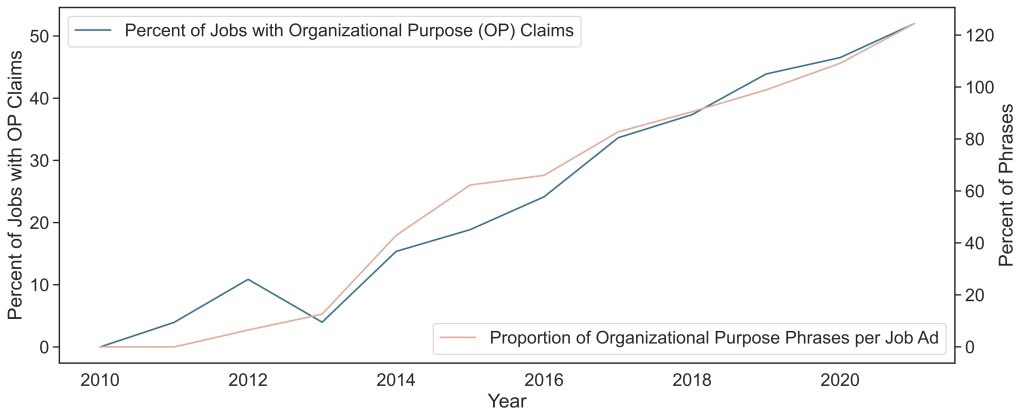
Notes: The figure illustrates the change over time in the percentage of job postings featuring organizational purpose claims (blue) and the average percentage of purpose-related phrases per job posting (orange), using 2010 as the base year.
Distribution of Variance in Organizational PurposeClaims Across Firms and MSAs

Notes: The figure illustrates the distribution of variance in the inclusion of organizational purpose claims within the same year, comparing within-MSA variance across firms (blue) and within-firm variance across MSAs (red). The within-MSA across firms variance captures differences in purpose claims among firms operating in the same MSA and year, where greater variation is expected. In contrast, the within-firm across MSAs variance reflects differences in a single firm’s use of purpose language across multiple geographic areas. This distribution indicates that the same firms incorporate purpose claims in job postings in some locations but not others, suggesting geographic variation in firms’ signaling strategies.
Distribution of Variance in Organizational Purpose Claims Use within Firm and Occupation across MSAs
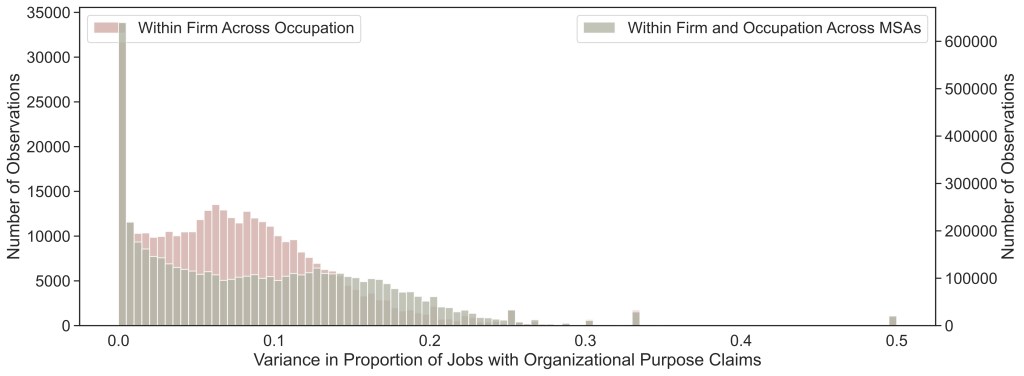
Notes: The figure illustrates the distribution of variance in firms’ use of organizational purpose claims within the same year, comparing variance within firms across occupations (pink) and variance within the firm-occupation pairs across geographies (green). The within-firm across occupations variance captures how firms’ use of purpose claims differs across jobs in different occupations within the same firm. The within firm-occupation variance reflects how firms vary their use of purpose claims for the same occupation across different geographic locations.The distribution shows that, even after accounting for occupation, firms do not uniformly apply purpose claims across job postings, suggesting that geographic and local labor market conditions influence their messaging strategies.
Relationship between Organizational Purpose Claims and MSA Unemployment

Notes: The figure presents the relationship between MSA unemployment rates and firms’ use of organizational purpose language in job postings.

